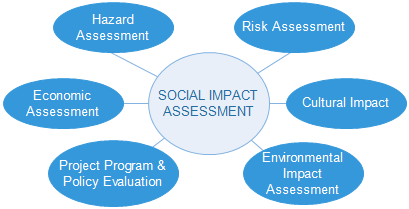
Social Impact Assessments (SIA) are a management tool. They provide the investor/ developer/ planner with socio-cultural data about a particular area or community that is going to be affected by their development plans, and they can predict the likely impact of the development upon the area or community. Increasingly in today's world there is a demand from the consumer for an ethical and socially responsible form of development.
Perhaps, more importantly, organizations like the World Bank, the EU and national governments are placing more emphasis on sustainable development. Consequently, the developers must be seen to be addressing these central issues within their strategies.
Social Impact Assessments are carried out prior to a project being built or expanded. Many investors, planners and developers do not want the local communities to know about the plans for development until the project has actually been developed to reduce the likely impact of public objections and/or steep increases in land values, surrounding the proposed project site.

As anthropologists we adopt a methodology based around qualitative and ethnographic research. This includes: participant observation and observation – living in and/or observing a community in precise detail, learning to understand the community; social and life histories – this involves studying the change, development and continuity in community life cycles; ethnographic mapping – this technique involves identifying important features of the landscape in which the community live.